
Forum › Until the Spotlight Falls discussion

This is packed full of angst until the end, but that ending seems a bit abrupt.
Oh well, it was nice for a little bite-sized reading, even if the childhood pal 'yuri' is quite bitter.

Sometimes dreams just don't come true. Sometimes It will come a day when what you love the most will become a chore and the greatest source of your unhappyness. Such is life.
I’m not sure I understand the ending? Anyone wanna try filling me in? Lol

This hurt...

im not sure i fully got that. but i think her actual dream/goal was to be like the other girl but she's not necessarily passionate or interested in the girl's hobbies/interests. so eventually drama became suffocating and she got really sick of it. but she feels like she has to be frustrated because otherwise she's not like her idol/rival who she believes to be super passionate about it. but then at the end she finds out that the girl's dream is to be a doctor and it's just like the hair thing where there's really no special attachment for one thing or another (i.e. she cuts her hair bec its hot in the summer, she's not attached to the long hair). and it all just makes the main girl feel hollow in the end?
but tbh im not even satisfied with this interpretation because of the last few pages. so im a bit lost.

Angst and this cute art style I'm in for a ride of sadness

im too dumb for this lol
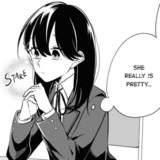
“Joy/anger/sorrow/bliss” is an extremely effective motif – original, punchy, weird but entirely plausible in the story. The first time it appears, the girls do it together, but it quickly switches to Machi doing it alone; very evocative of the distance she feels between her and Miyuri. The use of facial expressions specifically is in keeping with the theme of Machi’s emotional denial in the story. And since “joy/anger/sorrow” reflects the emotional arc of Machi in the oneshot, it can also be seen as implying a happy end to the story, where she learns to accept her disinterest in drama and rebalances her relationship with Miyuri.
The progression of Machi discovering her feelings is well-executed. Because we live in Machi’s head, we too experience her denial: we only notice things are off in fleeting thoughts and through the opinions of others. Each time it returns, we learn a little more about what’s really going on, but also learn more about how much she’s suppressing – quite literally depicted by Machi covering her mouth on page 9. Her idea of them being rivals being spun from an off-hand comment really effectively emphasizes its flimsy nature; the rapid and jarring switching between convincing herself of it at knowing it’s not true is an effective depiction of a deteriorating mental state.
The visual symbolism is effectively done, reminding me a lot of A Curtain Call for You; the spotlights and confetti progress from two people in the spotlight, to one person, to her younger self, to the end of light entirely, with obvious implications for the story. Page 13, the last panel on page 21, page 22 and page 32 are especially striking, just working very well composition-wise.
Overall, I had no idea Aizaki Utau had in in her. This is one of the best oneshots I’ve read in a while, and proves she can write can write excellent stories with emotional weight as well as the comedies she’s known for. This reads as very personal and cathartic for her, but I hope she can continue writing more in this vein.

Nerd alert
2.jpg?1641781308)
“Joy/anger/sorrow/bliss” is an extremely effective motif – original, punchy, weird but entirely plausible in the story. The first time it appears, the girls do it together, but it quickly switches to Machi doing it alone; very evocative of the distance she feels between her and Miyuri. The use of facial expressions specifically is in keeping with the theme of Machi’s emotional denial in the story. And since “joy/anger/sorrow” reflects the emotional arc of Machi in the oneshot, it can also be seen as implying a happy end to the story, where she learns to accept her disinterest in drama and rebalances her relationship with Miyuri.
The progression of Machi discovering her feelings is well-executed. Because we live in Machi’s head, we too experience her denial: we only notice things are off in fleeting thoughts and through the opinions of others. Each time it returns, we learn a little more about what’s really going on, but also learn more about how much she’s suppressing – quite literally depicted by Machi covering her mouth on page 9. Her idea of them being rivals being spun from an off-hand comment really effectively emphasizes its flimsy nature; the rapid and jarring switching between convincing herself of it at knowing it’s not true is an effective depiction of a deteriorating mental state.
The visual symbolism is effectively done, reminding me a lot of A Curtain Call for You; the spotlights and confetti progress from two people in the spotlight, to one person, to her younger self, to the end of light entirely, with obvious implications for the story. Page 13, the last panel on page 21, page 22 and page 32 are especially striking, just working very well composition-wise.
Overall, I had no idea Aizaki Utau had in in her. This is one of the best oneshots I’ve read in a while, and proves she can write can write excellent stories with emotional weight as well as the comedies she’s known for. This reads as very personal and cathartic for her, but I hope she can continue writing more in this vein.
This definitely helped me figure out most of it but there are still parts I'm not quite understanding.
The way I'm interpreting this is that she's feeling pretty hollow because she no longer cares about her one (former) dream. She's not unmotivated about acting because Miyuri is better than her, she's just lost interest in it. She wishes she were frustrated by Miyuri being better, that she could see her as a rival, but she doesn't because she doesn't care about it anymore. And not caring about it frightens her because she has nothing else.
Which takes me up to page 26, but 27 to the end I'm still confused about. Was Machi going to use Miyuri wanting to be an actress as an excuse to pretend for longer? And since Miyuri is clearly saying she wants something else, Machi has nothing left, no excuses left to hide from feeling completely empty? But then page 29 implies there is an element of copying Miyuri and Miyuri not caring here as well which I don't see how it ties in with everything.
I wish this had a few more pages so I could see how Miyuri reacts to Machi quitting the club.
...
This definitely helped me figure out most of it but there are still parts I'm not quite understanding.
The way I'm interpreting this is that she's feeling pretty hollow because she no longer cares about her one (former) dream. She's not unmotivated about acting because Miyuri is better than her, she's just lost interest in it. She wishes she were frustrated by Miyuri being better, that she could see her as a rival, but she doesn't because she doesn't care about it anymore. And not caring about it frightens her because she has nothing else.
Which takes me up to page 26, but 27 to the end I'm still confused about. Was Machi going to use Miyuri wanting to be an actress as an excuse to pretend for longer? And since Miyuri is clearly saying she wants something else, Machi has nothing left, no excuses left to hide from feeling completely empty? But then page 29 implies there is an element of copying Miyuri and Miyuri not caring here as well which I don't see how it ties in with everything.
I wish this had a few more pages so I could see how Miyuri reacts to Machi quitting the club.
your interpretation clarified things for me so thank you. my interpretation is actually that it's kind of like a ship dynamic, like "hollow person pretending to be passionate meets shoujo heroine who gives everything her all".
it's not that Machi "no longer cares", she never cared in the first place. her primary goal was to measure up against Miyuri, as evidenced by the flashback to when she grew out her hair. her fear stems from realizing that she doesn't actually value any of the things she has been putting her attention towards outside of their relation to Miyuri.
the "fade to black" is the curtains closing on the whole charade of acting like she ever really cared about the hair, about acting, or about anything besides measuring up to Miyuri. And Miyuri's declaration that she wants to be a doctor finally released Machi from the role as the rival, so to speak, both by removing the value of competing with her in acting (because Miyuri does not want to be an actress) and by affirming to Machi the futility of trying to compete with Miyuri in what Miyuri is interested in (versus pursuing things Machi herself is actually interested in).
Also
Nerd alert
27 to the end is just concluding what you’ve already written down. I think what’s happening is that Machi believes Miyuri has forgotten the dream, but isn’t quite 100% sure, and is therefore feeling conflicted. And this wraps up the story by providing complete confirmation, and therefore resolution for Machi’s turmoil.
I don’t think it’s that she feels completely empty at the end, it’s just that the dream of becoming an actor specifically has “faded to black” – finally put to rest. Page 29 shows that the dream mostly only existed anyway because Machi wanted to copy Miyuri, so it explains why Miyuri confirming that she has dropped the dream provides a final closure: the very last reason Machi wanted to hold on to the dream is gone.
The thing about this is, to be much more simplistic than some of the discussion above, as I read it I was thinking "So, she's in love with the blond girl, right? But she's like in sort-of-denial and stuff. And there's some other stuff."
But then at the end I was thinking "Wait, so is she in love with the blond girl or what? And how does the career change stuff have anything to do with that?"
But then at the end I was thinking "Wait, so is she in love with the blond girl or what? And how does the career change stuff have anything to do with that?"
They're stupid kids so the mc thought their dream would keep them together forever. Obviously if the mc communicated her feelings they could've stayed together despite having different careers. But because the mc placed so much worth into their dream she took Blondie's career switch as a rejection. The career dream was an illusion. The mc cared more about staying with Blondie than becoming an actress, that's why she placed so much importance in little things like changing her hair. Blondie was just going through the motions, so she supposedly never loved her back.
We sometimes hurt ourselves by holding onto ideas of ourselves or dreams for our future. We and the people around us convince us that we show promise for something, that we have passion for something, that we should pursue something. Certainly, sometimes we're right, but sometimes, regardless of passion or skill, it just isn't something we can or want to truly pursue. But we get locked in our heads that this has to provide us happiness, that at some point something is just going to click and it'll all be worth it, because the other option seems to be that it was all for naught.
But, y'know, that's okay. It's okay for something to have been pointless. And being able to have that moment, where all the pretense and pressure suddenly falls away, it might leave you feeling hollow. But there's a relief in no longer being filled with thorns. It hurts to rip them out, but it lets us step back and fill ourselves with the things that make us feel warm and happy.
As one of many "burnt out gifted child"s, crashing and burning out of my first semester of college was painful and hurt like hell in the moment. But ten years on, I don't really care anymore. I enjoy the work I do now, simple as it may be. I pursue hobbies of designing tabletop games, I go on trips with friends, I'll be moving in with my boyfriend of six years later this year. The dreams I once had as a kid are gone, but thinking back to my memories of those times, I still think every second was worth it.
Idk... Feels like machi is super serious with acting but never got any role so she lost interest. She seems burnt out. Doesn't help that everyone thinks, or at least she thinks everyone thinks that childhood dreams can be so easily let go. Miyuri doesn't give a shit just like the others and it kind disconnect her with her friend at the end.
I think the ending is happy, she is finally free of everything, the last page makes it seems dark, but she was happy when her friend said she wants to be a doctor, it’s like she can finally breath.
If I had to explain this one-shot to the people confused, it’s like Mob Psycho 100 (lol) where a lot of the conflict comes from kids wanting to be special, feeling inferior, measure oneself against others, all of this because you don’t see worth in yourself, because you don’t feel enough, you feel inferior, etc. Your worth is not on yourself but in others or in what you can do (and how big is what you can do compared to others do). In this one-shot all of that is broken and she is left with nothing, the curtain goes down and everything is black but according to me, at least she is no longer tied to anything.
She give herself worth because she was the rival of someone awesome, she used that as metric for herself and as a goal to achieve, for the friend it was never like that. For our MC it was everything.
It gave her confidence to think that she was her rival and lived through her. “if she is that great and I am her rival, it means that at some point I will catch up or surpass her” but for the friend it was not like that, the shock turned her entire structure upside down but at the same time, what's the point of living like that?
I think this is a story about feeling like you’re being left behind. Machi feels childish for hanging on to the dream of becoming an actor while Miyuri has a serious plan for the future. Even worse, Miyuri could have a real shot at fulfilling their shared dream but doesn’t want to. But I think the thing the bothers Machi the most is that she’s so envious and upset about the whole situation, while Miyuri is so earnest and humble. Hence why she tries so hard to suppress her negative feelings and pretend that she too has moved on.