
Forum › Goodbye Lara (open spoilers)

Honestly, my view is:
Hatred for the ending is pretty justified; It's not good.
I can follow what CPK said and come to my own conclusions of the meaning and relationships and the future of the characters in an ending that is purposefully left vague.
I think its a little silly that people are treating the ending like it evaporates all yuri in the show out of thin air cause its so obvious what the story was trying to tell you throughout the entire series about the relationship between Lara and Mari and their feelings towards each other when paying attention to words and symbolism used throughout.
I would completely understand this reaction if the story pulled a full on School Days, like Suicide Parabellum, but it's a bit confusing when the ending is this vague, lol.
Do not that I take this stance because I can enjoy media that was really good throughout but had a terrible ending. For example, I really like Crystal Project, whose final dungeon, boss(es), and ending I dislike with a burning passion. But, like, I dont really care, cause it's like 1/75th of the full game. For context, Lara's ending is about like, what, 4 minutes? Which is about like, an 84th of the entire show.
.jpg?1694589253)
gotta admit tho if seeing fanarts pisses u off that's a massive skill issue, like damn go get mad at all the noncanon yuri on this site then lmao
You all have written a shit ton on this, I've seen borderline novella-length articles as well in various places on social media. I could too, in the usual fashion I've seen, but I'm tired. I'm really, really god awfully tired of the whole sthick where we pretend to have amnesia about the very long history of how lesbian relationships are treated in media and how that informs the contemporary circumstances and how we ought to gauge them. And especially in Japan, where its historical and material conditions have led to a particular handling of lesbian stories in the line of what we see here.
A good primer on this (which also discusses Japanese-specific history!), is this video essay "The yuri was always doomed": https://youtube.com/watch?v=ciY9IM8a-GU .
Instead, I am going to write a long post in the way that I feel like. I am going to ignore a lot of what others consider necessary evidence to establish because I categorically refuse to entertain this nonsense, honestly.
I, also, frankly do not care to entertain the whole "well maybe the authors meant XYZ" or it was "supposed to be this way". I am much more interested in the:
A. Actual story as it appears to the audience and;
B. The historical and material circumstances giving rise and influence to the story's formation.
(A bit of a non sequitur) We use the word "chair" for chairs in English not because of any special reason, any hidden ultimate truth, but for the material conditions we grow up within. A "chair" is a "chair" because of its psychosocially-instilled form and function which we learn to label. This grows outwards of a long chain of human behavior and cultural norms that proceeds from generation to generation, society to society. Often even coming forth from the wide upheavals the many, many invasions of imperialist design have wrought upon us collectively. Studies have even shown that there's been a massive decrease in language proliferation due to the hegemony set up by these empires conquering large swaths of human civilization. So on.
In that sense I am not of the mind to speculate on authorial intent. It's much more productive to analyze the story's design from the looming influences in the room. It's often conflated that the mind forms very originally and from there comes the social context and behavior of a person. This is backwards: the social context is where the mind actually grows into being.
Your circumstances initiate the ongoing dialogue between your mind and your social context. People have autonomy, but they do not choose the circumstances they originate in, and those have much influence.
Hence, with that out of the way, this story ended like shit:
\1. Mari's character development was criminally underbaked:
Mari was given many trials: her mom's passing, her consistent grief as symbolized by her cross necklace, her own dismissal to how she (evidently) cared about Lara (going so far as to get visibly jealous), how her long-time friend "Gon-Chan" (Grace) died suddenly, how her inability to sufficiently aid Lara effected her emotionally, how Lara then decides to leave her (if temporarily, even if technically not-so-far). Not to mention literally being killed and revived by her crush. None of these are solved satisfyingly, or perhaps more objectively, it was done so unconvincingly. She is fifteen (?) years old. If she were a real life person I would expected debilitating trauma that she would need intensive therapy for. This is some fucked up shit. Even trying to be lenient about it, many are left with the impression that she was royally screwed over, consistently by each subsequent story beat. This is hard to argue against without sounding deranged.
\2. The thematic trajectory takes a fucking U-Turn at the end
This is really not hard to establish. Many here and elsewhere have argued to the contrary, that there were many hints of this theme of "independence" portion being key. I agree, somewhat. What I do not agree with is the implications that are poorly demonstrated from this facet. The simple truth of the matter is that it was borderline beat into our heads that choosing Mari as a love interest was a choice barred from Lara! The show, perhaps without intention, followed a thematic throughline of some pretty extreme comphet behavior. Lara ignored her own feelings over, and over, and over, and over. Meanwhile, an alternative was pantomimed in front of audience in a distinct Mari-shaped manner over, and over, and over.
There were hardly any hints of the outcome that the small 6-month timeskip section grew to be. While again, several have argued that the LaraMari Chekhov's gun was indeed fired in the form of a couple small clips and statements by the characters (which seems like an absurd point to make with how much more explicitly, and with more screen time, the conclusion of the relationship between Lara and Luca came to be), it is much more accurate to say it misfired and the bullet had stayed in the barrel.
It is really hard to unsee, that, from the trajectory the story was taking, Lara choosing Mari could have only been considered as a step towards independence. That her love was her own and not a duty and/or a destiny. "Live for love, not for laws," correct?
Let's say this is a cage too, that she had to free herself from. Sure. I am only certain (wow I am not being sarcastic at all /s) that a groundswell of genuine emotional attachment to another person is a cage. We must free ourselves for the certainty of steel yada yada. Kill your earthly attachments and reach enlightenment within my weird individualist fetishism where we pretend, for a moment, that the atomic family is a holy ordained construct that humans must approach or they end in disaster. This could not possibly be a bullshit culturally imposed ideal. What do you mean MY human psychology is usually reliant on long-lasting relations with other people? I should go throw myself into a low-income apartment with absolutely zero lifelines! How smart and satisfying to my personal development. How very rational.
(What Lara really should have done, in the extreme of this aburdist logic, is have ran off from the beginning perhaps, or let Mari die and revived her 20 years in the future after growing up to become a surgeon with a very sizable 401k and have gone through 13 different husbands to make absolutely sure she was totally and completely gay. And not that fake bisexual shit that they teach you in The Gay School that is state-mandated.)
I am intentionally straw-manning to beat you over the head with my point. To be blunt: kids have relationships. Sometimes, no, often, poorly. This is ok. It is ok for them to go into a relationship neither of them are "ready" for, since that is precisely how people do get ready: making mistakes. This is what kids do, they get in over their heads, they fuck up a basic interpersonal situation, they feel like shit and like the world ended, and then the world moves on. They grow, they learn, and next time they try they know a bit better about how to treat each other.
Yes, of course, it is possible to be unhealthily codependent, or so on. And it's certainly possible to take some time to work on yourself instead of throwing your weight in the ring immediately. But none of that alleged potentiality locks off Lara and Mari from each other prima facie. What an absurd, almost borderline snobbish perspective to take, in the light of the story we were presented, that Lara was somehow knowably unready for love. Her last real attempt isn't exactly a fair strike. That prince literally tried to kill her.
But who's argument am I fighting against here? A culmination of claims, perhaps. Maybe I'm fighting ghosts. But my conclusion remains the same: There would be no real narrative issue with it have culminating in an explicitly dictated relationship; on the contrary it would have only made the most narrative sense on the trajectory we were on.
Frankly the whole "time away" thing would have made more natural sense after a messy breakup from bullshit miscommunication. The standard death of young love of pretty much any fashion. And, wherein, for the purposes of this narrative it could have been left on an upbeat note that they'd reunite after "finding themselves" or some relevant fluff. I would have respected that much more. One has to wonder why the option doesn't seem to ever be on the table...
\3. They slaughter Lara's characterization
As well as independently observable, it has been stated everywhere her demeanor becomes "cold" the timeskip segment; that she is stand-offish, unresponsive, so on. She acts completely unlike herself. Beyond what many have said, I find it personally insulting that this seems to be design to paint her as changed; "grown up" even. Like, personally insulting. Emotions are treated as a childish, vapid thing in many cultural contexts we find ourselves in. What a shallow lie we get shoved down our throats on the regular. Do I even have to deign to disprove it? You surely understand, by now, how nonsensical that is. Surely, we've learnt this.
Another point: Part of Lara's charm as a character, and what made her ostensibly "Lara" in the eyes of the audience as they watch her move from experience to experience, is the genuineness of her emotional response. The sheer honesty and fullness and awe with which she interacted with in the environment.
So while we can speculate about authorial intent in making her appear "grown up", well, you already know how I feel about that. Also, A: That's bullshit and a terrible message to send. B: You just threw out the baby with the bath water.
In this way, we say "goodbye" to Lara twice in the same ending. Once, to Lara as we knew her, and again to her hollow shell as she gets on the train. What a waste. There was hardly, also, any characterization to refill what "Lara" became. She was left with nothing after they ripped out her soul.
\4. Subtlety was neither used much, nor of much strength
As a last point in the ghost-fighting match I have clearly taken on, I'd like to fight against the culmination of impressions that a lot of the narrative design can be rationalized under the banner of an intentional "subtlety". That it need not be, in-your-face.
There's a number of problems with this. It may or may not have to do with Lara's history and grievances with love being demonstrated with a giant man-eating fish-monster-dagger thing that literally eats peoples' souls. And that we had an entire in-house explanation of it thrown at us from Grace's subplot. It may also have to do with the fact that Lara herself is anything but subtle in any way whatsoever. She is criminally unable to be subtle. Lara "I Would Die for Cake" McSubtle?
Except, I suppose, when leaving Mari. Or when discussing her love towards Mari. Hm.
And, of course, my philosophical stance on authorial intent: Bluntly it's just incorrigible with the story as presented. But I suppose I must give them the benefit of the doubt when it uniquely seems to be applied to the centerpiece relationship of the story. Which just happens to be of the lesbian kind. In Japan. Hmmmmmmm...
IN CONCLUSION:
To re-include, finally, the surrounding social and cultural context. This is not a new direction this media category has taken. Lesbian media has always been treated in this strange standoffish, inability to be explicit, kind of way. Especially and particularly in Japan. The flailing, fledgling and doomed romance of young girls, as so demanded.
Sure enough you could take a butcher knife and mercilessly remove this context, tear out the organs and taxidermy the body, and call it something entirely different: that stories should be allowed to be this way, that this is just another facet of human experience, yada yada.
Perhaps you are right in the fiefdom of your mind. In a lobotomized scope of literature, the ending was at worst kinda mid. Indeed.
In the known history and experience of lesbian media, on the other hand, it was murder on soil soaked red with that of thousands before. I can't see it as anything but. I refuse to be charitable.
Now, if only everyone could stop trying so hard to hide the bodies, that would be great.
last edited at Sep 23, 2026 1:32AM
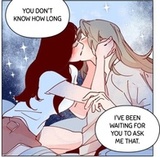
\3. They slaughter Lara's characterization
As well as independently observable, it has been stated everywhere her demeanor becomes "cold" the timeskip segment; that she is stand-offish, unresponsive, so on. She acts completely unlike herself. Beyond what many have said, I find it personally insulting that this seems to be design to paint her as changed; "grown up" even. Like, personally insulting. Emotions are treated as a childish, vapid thing in many cultural contexts we find ourselves in**. What a shallow lie we get shoved down our throats on the regular. Do I even have to deign to disprove it? You surely understand, by now, how nonsensical that is. Surely, we've learnt this...
...In this way, we say "goodbye" to Lara twice in the same ending. Once, to Lara as we knew her, and again to her hollow shell as she gets on the train. What a waste. There was hardly, also, any characterization to refill what "Lara" became. She was left with nothing after they ripped out her soul.
Yes. There's just a lot that can be said about it from a narrative standpoint that has little to do with their getting together at the end.
Subtlety was neither used much, nor of much strength
As a last point in the ghost-fighting match I have clearly taken on, I'd like to fight against the culmination of impressions that a lot of the narrative design can be rationalized under the banner of an intentional "subtlety". That it need not be, in-your-face.
There's a number of problems with this. It may or may not have to do with Lara's history and grievances with love being demonstrated with a giant man-eating fish-monster-dagger thing that literally eats peoples' souls. And that we had an entire in-house explanation of it thrown at us from Grace's subplot. It may also have to do with the fact that Lara herself is anything but subtle in any way whatsoever. She is criminally unable to be subtle. Lara "I Would Die for Cake" McSubtle?
Except, I suppose, when leaving Mari. Or when discussing her love towards Mari. Hm.
Especially agreed here. Its part of why I've been a bit confused by discussions of ambiguity and such. There wasn't much of any of that in the series except regarding her relationship to Mari and even that was only condensed to the ending. In every other way the story was directly building them up and using exact language. It only became avoidant at the very end, which is part of the reason for the massive annoyance. It was otherwise a very blunt, straightforward series in nearly every other aspect, using very clear metaphors as you mentioned.
last edited at Sep 23, 2026 2:26AM

@AknownymousInput Made a new account just to drop a paragraph of facts and dipped haha :D
@AknownymousInput Made a new account just to drop a paragraph of facts and dipped haha :D
God knows I'm going to end up doing it again. The law of doomed yuri will remain in Japan probably up until the point they have a social revolution and completely revamp their cultural context. Or something.
I don't know. I'm very cynical. Sometimes it feels as if there's a secret cabal of people conspiring to yurbait people over yonder. (In reality of course it's a very non-secret cultural circumstance with many decades of history in the making. But bleh. I like imagining there's evil people who can croak and then circumstances will magically get better without a long protracted effort of many thankless "nobodies" who make up the real history of the world.)
gotta admit tho if seeing fanarts pisses u off that's a massive skill issue, like damn go get mad at all the noncanon yuri on this site then lmao
Agreed. I get why some people feel pissed off or even a little triggered when they see fan art of them together, especially if it immediately brings back that whole “ah fuck, it could’ve been” feeling from those last five minutes of the ending. If you were heavily invested in Lara and Mari and felt the ending deliberately pulled them apart, I can see why seeing people keep portraying them as a happy couple might bring those feelings back.
But as you said, IT IS fanart. At the end of the day, fanart isn’t obligated to follow the canon ending, nor does the artist have to interpret the characters or their relationship in the exact same way the original creator did. If someone wants to draw Lara and Mari together, happy, and openly in love because that’s how they personally interpret their relationship or how they wish things had ended, then great. Honestly, I’d love to see more of that because that’s one of the fun parts of fandom. And beyond that, they’re a ship. Once a pairing becomes popular, people are obviously going to make ship art of them.
My conclusion: people gotta grow up
im so disappointed with that ending its a yuri bait wasted my time watching it that is my last and never again
last edited at Sep 23, 2026 3:04AM
@AknownymousInput Made a new account just to drop a paragraph of facts and dipped haha :D
God knows I'm going to end up doing it again. The law of doomed yuri will remain in Japan probably up until the point they have a social revolution and completely revamp their cultural context. Or something.
I don't know. I'm very cynical. Sometimes it feels as if there's a secret cabal of people conspiring to yurbait people over yonder. (In reality of course it's a very non-secret cultural circumstance with many decades of history in the making. But bleh. I like imagining there's evil people who can croak and then circumstances will magically get better without a long protracted effort of many thankless "nobodies" who make up the real history of the world.)
Social revolution, or at least until the heavy sexualization of women in the country starts to change. When you look around, there’s this constant expectation for women to be attractive, sexualized, and held to a much higher standard than men, whether it’s real women or even fictional anime characters. I honestly wonder if that broader cultural attitude toward women is part of why “doomed yuri” feels so common and acceptable there. Like, women can be portrayed as deeply intimate with each other, emotionally dependent on each other, and even obviously in love, but there still seems to be this reluctance to let that relationship actually become something permanent and openly romantic. It’s almost like the intimacy is acceptable as long as it doesn’t fully cross that final line into an explicit, lasting relationship.
im so disappointed with that ending its a yuri bait wasted my time watching it that is my last and never again
By “last and never again,” do you mean you’re never going to watch yuri again? Because there were actually two official, genuinely yuri anime airing this season: Young Ladies Don’t Play Fighting Games, and I Want to Love You Till Your Dying Wish.
So this season we had two wins and one loss
@AknownymousInput Made a new account just to drop a paragraph of facts and dipped haha :D
God knows I'm going to end up doing it again. The law of doomed yuri will remain in Japan probably up until the point they have a social revolution and completely revamp their cultural context. Or something.
I don't know. I'm very cynical. Sometimes it feels as if there's a secret cabal of people conspiring to yurbait people over yonder. (In reality of course it's a very non-secret cultural circumstance with many decades of history in the making. But bleh. I like imagining there's evil people who can croak and then circumstances will magically get better without a long protracted effort of many thankless "nobodies" who make up the real history of the world.)
Social revolution, or at least until the heavy sexualization of women in the country starts to change. When you look around, there’s this constant expectation for women to be attractive, sexualized, and held to a much higher standard than men, whether it’s real women or even fictional anime characters. I honestly wonder if that broader cultural attitude toward women is part of why “doomed yuri” feels so common and acceptable there. Like, women can be portrayed as deeply intimate with each other, emotionally dependent on each other, and even obviously in love, but there still seems to be this reluctance to let that relationship actually become something permanent and openly romantic. It’s almost like the intimacy is acceptable as long as it doesn’t fully cross that final line into an explicit, lasting relationship.
The commodification of women, the patriarchal distribution of resources, and the gendered (and invisible) nature of reproductive labor are some toxic shit and socioeconomically entrench the oppression of women nationally & internationally. Such things must be dug out root and stem, for the liberation of women everywhere.
Absolutely the largest factor, for sure. You can easily see it poison the well of "non-doomed" yuri wherein the characters are made into shallow reflections of stereotypical gender roles and objects of sex appeal.

Ambiguity has been part of lesbian (and gay) stories because of what has been allowed to be told in stories due to oppression, censorship, and sometimes cowardice. I'm not denying that it's part of the history of queer relationships around the world, more so rejecting the idea that it's a "core" part of it, I rather acknowledge the history and evolve from it. As we move past ambiguity in our strive for better representation. Yuri to me is Sapphic relationships and the many forms it comes in, it's more than merely friendship like you describe so yes we'll have to agree to disagree. I've also seen the regular responses to this whole thing from your side as well, so it what it is. Also yes I do see it as cowardice when Lara swerves away from intimacy to ultimately release a safer narrative that attempts to appeal to a wider audience, including the ones that might be scared of a few L words like Love and Lesbian lol
Agreed. It's not that complicated and these relationships don't need poetics to explain them. Two girls dating isn't the birth of a new universe. There's little reason other than authors denying reality. It's not a coincidence that this ambiguity issue is a problem moreso in works from more socially conservative countries with creative traditions that still struggle to be open about queer relationships as widely. Outside of manga this issue is not present in the same way at all.
I'm not really understanding this discussion of breaking boundaries and being indefinable. It's definable. They date. They hang out. It's normal human stuff. Nothing is ambiguous about it. Other creators manage just fine. My webtoon series subscription list is currently filled with writers who have somehow managed to figure that out. I've read countless novels that did so as well and some good graphic novels recently. Other mangaka have figured it out, many of them favorites of this very site. I just feel like we're making this more complicated than it is and it feels like a cover less willing authors can use forever. "Are they dating, you ask? Well, I can't answer that, you can decide. And honestly we should first discuss the meaning of the word dating, and how nebulous that term can be..." I wish more authors talked like that and behaved this way in the non-yuri series I read so I could see how those readers would take it.
I'm crashing so I'll just say I agree and your reply offers good food for thought!
They show lots of physical intimacy in the new sequel manga.
CPK sequel manga? Tell me more.

Those long ass well-articulated paragraphs are why we should bring back forums and blogs instead of whatever the fuck web 3.0 is doing. And I agree about Lara, she treated Mari so badly I don't to see them together anymore. Mari deserves someone who won't let her down and treat her so coldly.
It's not like being ambiguous and/or doomed is some unbreakable law of Japanese culture. There are tons of perfectly explicit (in various senses) yuri manga, and LNs just in translation (probably a lot more without good translations), and even over a dozen anime series. WataOshi, Watanare, MagiRevo, Kannazuki no Miko, Whispered Words, Strawberry Panic, Citrus, Whispering a Love Song, Bloom Into You, and more. It is perfectly possible for an anime to be both explicitly gay and have a happy ending (though often, the anime has a bit of fizzle ending because it's adapting something much longer than the anime -- yuri not getting a second season seems closer to a real law, sadly.)
Japan has given us Rae Taylor saying she likes girls, and only girls. Anis and Euphie having fairy rainbow flight and ending with Euphie asking when Anis will kiss her on the lips. Kazama crushing on every cute girl except her friend Sumika who likes her. Touko macking on Yuu. Yori confessing to Himari.

You all have written a shit ton on this, I've seen borderline novella-length articles as well in various places on social media. I could too, in the usual fashion I've seen, but I'm tired. I'm really, really god awfully tired of the whole sthick where we pretend to have amnesia about the very long history of how lesbian relationships are treated in media and how that informs the contemporary circumstances and how we ought to gauge them. And especially in Japan, where its historical and material conditions have led to a particular handling of lesbian stories in the line of what we see here.
A good primer on this (which also discusses Japanese-specific history!), is this video essay "The yuri was always doomed": https://youtube.com/watch?v=ciY9IM8a-GU .
Instead, I am going to write a long post in the way that I feel like. I am going to ignore a lot of what others consider necessary evidence to establish because I categorically refuse to entertain this nonsense, honestly.
I, also, frankly do not care to entertain the whole "well maybe the authors meant XYZ" or it was "supposed to be this way". I am much more interested in the:
A. Actual story as it appears to the audience and;
B. The historical and material circumstances giving rise and influence to the story's formation.(A bit of a non sequitur) We use the word "chair" for chairs in English not because of any special reason, any hidden ultimate truth, but for the material conditions we grow up within. A "chair" is a "chair" because of its psychosocially-instilled form and function which we learn to label. This grows outwards of a long chain of human behavior and cultural norms that proceeds from generation to generation, society to society. Often even coming forth from the wide upheavals the many, many invasions of imperialist design have wrought upon us collectively. Studies have even shown that there's been a massive decrease in language proliferation due to the hegemony set up by these empires conquering large swaths of human civilization. So on.
In that sense I am not of the mind to speculate on authorial intent. It's much more productive to analyze the story's design from the looming influences in the room. It's often conflated that the mind forms very originally and from there comes the social context and behavior of a person. This is backwards: the social context is where the mind actually grows into being.
Your circumstances initiate the ongoing dialogue between your mind and your social context. People have autonomy, but they do not choose the circumstances they originate in, and those have much influence.
Hence, with that out of the way, this story ended like shit:
\1. Mari's character development was criminally underbaked:
Mari was given many trials: her mom's passing, her consistent grief as symbolized by her cross necklace, her own dismissal to how she (evidently) cared about Lara (going so far as to get visibly jealous), how her long-time friend "Gon-Chan" (Grace) died suddenly, how her inability to sufficiently aid Lara effected her emotionally, how Lara then decides to leave her (if temporarily, even if technically not-so-far). Not to mention literally being killed and revived by her crush. None of these are solved satisfyingly, or perhaps more objectively, it was done so unconvincingly. She is fifteen (?) years old. If she were a real life person I would expected debilitating trauma that she would need intensive therapy for. This is some fucked up shit. Even trying to be lenient about it, many are left with the impression that she was royally screwed over, consistently by each subsequent story beat. This is hard to argue against without sounding deranged.
\2. The thematic trajectory takes a fucking U-Turn at the end
This is really not hard to establish. Many here and elsewhere have argued to the contrary, that there were many hints of this theme of "independence" portion being key. I agree, somewhat. What I do not agree with is the implications that are poorly demonstrated from this facet. The simple truth of the matter is that it was borderline beat into our heads that choosing Mari as a love interest was a choice barred from Lara! The show, perhaps without intention, followed a thematic throughline of some pretty extreme comphet behavior. Lara ignored her own feelings over, and over, and over, and over. Meanwhile, an alternative was pantomimed in front of audience in a distinct Mari-shaped manner over, and over, and over.
There were hardly any hints of the outcome that the small 6-month timeskip section grew to be. While again, several have argued that the LaraMari Chekhov's gun was indeed fired in the form of a couple small clips and statements by the characters (which seems like an absurd point to make with how much more explicitly, and with more screen time, the conclusion of the relationship between Lara and Luca came to be), it is much more accurate to say it misfired and the bullet had stayed in the barrel.
It is really hard to unsee, that, from the trajectory the story was taking, Lara choosing Mari could have only been considered as a step towards independence. That her love was her own and not a duty and/or a destiny. "Live for love, not for laws," correct?
Let's say this is a cage too, that she had to free herself from. Sure. I am only certain (wow I am not being sarcastic at all /s) that a groundswell of genuine emotional attachment to another person is a cage. We must free ourselves for the certainty of steel yada yada. Kill your earthly attachments and reach enlightenment within my weird individualist fetishism where we pretend, for a moment, that the atomic family is a holy ordained construct that humans must approach or they end in disaster. This could not possibly be a bullshit culturally imposed ideal. What do you mean MY human psychology is usually reliant on long-lasting relations with other people? I should go throw myself into a low-income apartment with absolutely zero lifelines! How smart and satisfying to my personal development. How very rational.
(What Lara really should have done, in the extreme of this aburdist logic, is have ran off from the beginning perhaps, or let Mari die and revived her 20 years in the future after growing up to become a surgeon with a very sizable 401k and have gone through 13 different husbands to make absolutely sure she was totally and completely gay. And not that fake bisexual shit that they teach you in The Gay School that is state-mandated.)
I am intentionally straw-manning to beat you over the head with my point. To be blunt: kids have relationships. Sometimes, no, often, poorly. This is ok. It is ok for them to go into a relationship neither of them are "ready" for, since that is precisely how people do get ready: making mistakes. This is what kids do, they get in over their heads, they fuck up a basic interpersonal situation, they feel like shit and like the world ended, and then the world moves on. They grow, they learn, and next time they try they know a bit better about how to treat each other.
Yes, of course, it is possible to be unhealthily codependent, or so on. And it's certainly possible to take some time to work on yourself instead of throwing your weight in the ring immediately. But none of that alleged potentiality locks off Lara and Mari from each other prima facie. What an absurd, almost borderline snobbish perspective to take, in the light of the story we were presented, that Lara was somehow knowably unready for love. Her last real attempt isn't exactly a fair strike. That prince literally tried to kill her.
But who's argument am I fighting against here? A culmination of claims, perhaps. Maybe I'm fighting ghosts. But my conclusion remains the same: There would be no real narrative issue with it have culminating in an explicitly dictated relationship; on the contrary it would have only made the most narrative sense on the trajectory we were on.
Frankly the whole "time away" thing would have made more natural sense after a messy breakup from bullshit miscommunication. The standard death of young love of pretty much any fashion. And, wherein, for the purposes of this narrative it could have been left on an upbeat note that they'd reunite after "finding themselves" or some relevant fluff. I would have respected that much more. One has to wonder why the option doesn't seem to ever be on the table...
\3. They slaughter Lara's characterization
As well as independently observable, it has been stated everywhere her demeanor becomes "cold" the timeskip segment; that she is stand-offish, unresponsive, so on. She acts completely unlike herself. Beyond what many have said, I find it personally insulting that this seems to be design to paint her as changed; "grown up" even. Like, personally insulting. Emotions are treated as a childish, vapid thing in many cultural contexts we find ourselves in. What a shallow lie we get shoved down our throats on the regular. Do I even have to deign to disprove it? You surely understand, by now, how nonsensical that is. Surely, we've learnt this.
Another point: Part of Lara's charm as a character, and what made her ostensibly "Lara" in the eyes of the audience as they watch her move from experience to experience, is the genuineness of her emotional response. The sheer honesty and fullness and awe with which she interacted with in the environment.
So while we can speculate about authorial intent in making her appear "grown up", well, you already know how I feel about that. Also, A: That's bullshit and a terrible message to send. B: You just threw out the baby with the bath water.
In this way, we say "goodbye" to Lara twice in the same ending. Once, to Lara as we knew her, and again to her hollow shell as she gets on the train. What a waste. There was hardly, also, any characterization to refill what "Lara" became. She was left with nothing after they ripped out her soul.
\4. Subtlety was neither used much, nor of much strength
As a last point in the ghost-fighting match I have clearly taken on, I'd like to fight against the culmination of impressions that a lot of the narrative design can be rationalized under the banner of an intentional "subtlety". That it need not be, in-your-face.
There's a number of problems with this. It may or may not have to do with Lara's history and grievances with love being demonstrated with a giant man-eating fish-monster-dagger thing that literally eats peoples' souls. And that we had an entire in-house explanation of it thrown at us from Grace's subplot. It may also have to do with the fact that Lara herself is anything but subtle in any way whatsoever. She is criminally unable to be subtle. Lara "I Would Die for Cake" McSubtle?
Except, I suppose, when leaving Mari. Or when discussing her love towards Mari. Hm.
And, of course, my philosophical stance on authorial intent: Bluntly it's just incorrigible with the story as presented. But I suppose I must give them the benefit of the doubt when it uniquely seems to be applied to the centerpiece relationship of the story. Which just happens to be of the lesbian kind. In Japan. Hmmmmmmm...
IN CONCLUSION:
To re-include, finally, the surrounding social and cultural context. This is not a new direction this media category has taken. Lesbian media has always been treated in this strange standoffish, inability to be explicit, kind of way. Especially and particularly in Japan. The flailing, fledgling and doomed romance of young girls, as so demanded.
Sure enough you could take a butcher knife and mercilessly remove this context, tear out the organs and taxidermy the body, and call it something entirely different: that stories should be allowed to be this way, that this is just another facet of human experience, yada yada.
Perhaps you are right in the fiefdom of your mind. In a lobotomized scope of literature, the ending was at worst kinda mid. Indeed.
In the known history and experience of lesbian media, on the other hand, it was murder on soil soaked red with that of thousands before. I can't see it as anything but. I refuse to be charitable.
Now, if only everyone could stop trying so hard to hide the bodies, that would be great.
Holy shit you fucking KILLED it, this is pretty much exactly what I've been thinking about the show since that finale aired and it drives me up a wall seeing people twist themselves into pretzels to spin it positively.
It's not like being ambiguous and/or doomed is some unbreakable law of Japanese culture. There are tons of perfectly > explicit (in various senses) yuri manga, and LNs just in translation (probably a lot more without good translations), and
even over a dozen anime series. WataOshi, Watanare, MagiRevo, Kannazuki no Miko, Whispered Words, Strawberry
Panic, Citrus, Whispering a Love Song, Bloom Into You, and more.
I'm not capable or knowledgeable enough to take part in this conversation in ways that would bring satisfying comments.
But I'd like to say one thing - while are of course correct in what you said, aren't all those series or most marketed and described as "yuri". Japan can have "yuri" in "yuri", so to speak. Kind of like how you would expect a fantasy manga to have swordfighting, but your slice of life OL anime to have swordfighting is somewhat notable.
What would be very nice for Japan/broader East Asia to be capable of doing, at least much more, that in a series that isn't specifically "yuri" or marketed as such girls can still love and kiss and be happy, so that can be part of a "normal" series too, that they aren't in "yuri" version of tvtropes slash Animation Ghetto. This can nowadays happen at least occasionally in the "West" in series that aren't marketed as "this is a story about girls loving girls".
But I don't expect Japan to ever change, which isn't saying it -can't-. But I don't expect it to.
.jpg?1616287299)
I was actually mostly—and extremely—pissed off about that one Luca scene and the line about "dating and breaking up countless times" (wtf???), but looking more into it (and trusting the ever reliable reddit lol), it seems that this was just a (terrible) translation issue..
That line is still ambiguous, which is a large part of the whole issue with this bad ending. I've seen many Japanese fans who also interpreted it as "we've been dating on and off for the last 6 months" from Luka. I can't blame them because Lara showed such emotion during that scene, even crying.
It sucks that the Luca scene apparently was that ambiguous even for Japanese viewers. Why would you even re-open that subject just to re-introduce that ambiguity, when Lara very clearly had realized in previous episodes (and even stated outloud for viewers to hear) that she doesn't love Luca this way. I can't think of a single reason for Lara to want to explore a romantic relationship with Luca in those six months; if she wasn't sure about romance in general, then Luca definitely wasn't the person for her to explore it with. The only explanation I can think of for this decision really does go back to japanese media avoiding to fully commit to a happy lesbian ending.
I'm back to hating this ending, and I think @AknownymousInput has already explained all the reasons why much better than I ever could.
I'm going to have a weird take about the entire show, and that is Lara being a mermaid didn't actually matter that much to the story at least outside of providing her father a reason to hate humans
I'll agree with this take. I was really hoping to have Mari confront Lara's dad in the finale (maybe even punch him, just to tie her whole boxing thing in) but in the end he (and all the rest of the mermaids besides Lisa) never even got to meet a single human; it kinda makes the whole xenophobia/racism angle fall flat for me.
I agree with the person you're replying to and the idea of Mari punching the dad. That would actually be a great way to give Mari a more active role in the human/mermaid conflict and to give some reason for the boxing plotline that was kind of completely forgotten on the latter half of the show.
It's not like being ambiguous and/or doomed is some unbreakable law of Japanese culture. There are tons of perfectly explicit (in various senses) yuri manga, and LNs just in translation (probably a lot more without good translations), and even over a dozen anime series. WataOshi, Watanare, MagiRevo, Kannazuki no Miko, Whispered Words, Strawberry Panic, Citrus, Whispering a Love Song, Bloom Into You, and more. It is perfectly possible for an anime to be both explicitly gay and have a happy ending (though often, the anime has a bit of fizzle ending because it's adapting something much longer than the anime -- yuri not getting a second season seems closer to a real law, sadly.)
Japan has given us Rae Taylor saying she likes girls, and only girls. Anis and Euphie having fairy rainbow flight and ending with Euphie asking when Anis will kiss her on the lips. Kazama crushing on every cute girl except her friend Sumika who likes her. Touko macking on Yuu. Yori confessing to Himari.
Exactly! Is not that explicit yuri doesn’t exist nowadays, as you said multiple examples, that is why the ones that avoid it do it intentionally, that’s why imo is less about censorship or oppression (not that this doesn’t matter but I think Gundam Mercury was it’s own special cade) and more an active and conscious decision of the creators. Because both types of yuri series are popular.
It's not like being ambiguous and/or doomed is some unbreakable law of Japanese culture.
I can't tell if this is directed at me or not, but to clarify that's not at all what I'm suggesting (my comments about the "law of doomed yuri" were mostly tongue & cheek anyhow).
To be clear what I'm referring to is explicitly and particularly the consistent proliferation of this strange story archetype displayed in Goodbye, Lara and countless others.
I am making absolutely no claim that Japan is incapable of producing genuine lesbian media. Rather I'm saying Japan's culture has been and still today consistently does it dirty and I don't expect this to stop until some serious shifts happen.
Exactly! Is not that explicit yuri doesn’t exist nowadays, as you said multiple examples, that is why the ones that avoid it do it intentionally, that’s why imo is less about censorship or oppression (not that this doesn’t matter but I think Gundam Mercury was it’s own special cade) and more an active and conscious decision of the creators. Because both types of yuri series are popular.
Honestly I'm not sure what the point of the distinction is here. TBH this really goes back to why I spent so much time dismantling the idea that we should gaf about authorial intent. It's the results and the historical implication of the results that we should pay attention to. The fact that it's an "active and conscious decision" of the creators is basically immaterial to me. It might as well be, even if it's not. Either way I do actually think they hold a responsbillity to conduct these stories in a manner that doesn't add to existing pile of bs. Whether they "knowingly" did so or not!
At the end of the day the way this story went falls in line with the historical treatment of same-sex relationships in Japan quite handidly. There's a long history of this, in fact. Especially much from how same-sex relationships were treated in girls-only schools (they were basically treated as "training wheels" for "real" relationships by the girls' parents right up until western pseudo-scientific hompphobia became popular and then it was considered diseased!)
To view it out of this context, as I said as much earlier, is to essentially bang your head into a wall until you get amnesia.
And is this not another form of oppression? Why does it have to be an "explicitly" oppressive thing? Back during some of the USA's more racist years, and still today, black characters are so often treated in a particular manner harking back to a long line of racist handling of their being.
I'm not trying to attack you, to be clear! Rather I'd like us all to have, perhaps, higher standards for what is considered "non-oppressive" or mere "authorial choice". Knowing what I do, I can hardly begin to let this story slide as such.
last edited at Sep 23, 2026 12:15PM
It's not like being ambiguous and/or doomed is some unbreakable law of Japanese culture.
I can't tell if this is directed at me or not, but to clarify that's not at all what I'm suggesting (my comments about the "law of doomed yuri" were mostly tongue & cheek anyhow).
To be clear what I'm referring to is explicitly and particularly the consistent proliferation of this strange story archetype displayed in Goodbye, Lara and countless others.
I am making absolutely no claim that Japan is incapable of producing genuine lesbian media. Rather I'm saying Japan's culture has been and still today consistently does it dirty and I don't expect this to stop until some serious shifts happen.
Yeah the archetype feels like a disease that needs to be cured, and I was hoping that Lara would be a breakthrough finally as we keep getting hitting hit by this bullshit. Alas though maybe the next one will actually do something different and not take the coward's way out last minute.
Also expanding from Japan I just...want to see things improve in general. As someone that lives in the USA I don't want to live in a world where incredible series like Owl House get the short end of the stick by some upper management bigot. Where main stream American media still struggles to have LGBTQ characters and stories, but even outside of that main stream American media still struggles to have women leads. Which ties into issues with the patriarchy and some people still wanting even the worst of men ruining everything over a woman leader, and I digress as this isn't the place to get into that. I'm just...so incredibly tired of living in a world like this.
Also just responding to a snippet of your newest reply,
And is this not another form of oppression?
YES! This is something I've been trying to shout from the rooftops, it is very much still oppression and it sucks.
last edited at Sep 23, 2026 11:47AM
Honestly I'm not sure what the point of the distinction is here. TBH this really goes back to why I spent so much time dismantling the idea that we should gaf about authorial intent. It's the results and the historical implication of the results that we should pay attention to. The fact that it's an "active and conscious decision" of the creators is basically immaterial to me. It might as well be, even if it's not. Either way I do actually think they hold a responsbillity to conduct these stories in a manner that doesn't add to existing pile of bs. Whether they "knowingly" did so or not!
I never said anything about authorial intent being important (I even quoted Morishima Akiko “yuri is what you want it to be) I am saying these authors know and still choose to write like this because they like it, I myself said Sayonara Lala is yuri because there is plenty of yuri like that, it didn’t do anything special, but it’s not what some fans expect nowadays, a section wants the thoughts be voiced, but others don’t care and like this nebulous thing. And I also said you can consider that itself homophobia! I was just saying that it exist because yuri fans like it to this day. I give the example of MariMite, the author knows lesbian exist, but she still choose to play with ambiguity.
At the end of the day the way this story went falls in line with the historical treatment of same-sex relationships in Japan quite handidly. There's a long history of this, in fact. Especially much from how same-sex relationships were treated in girls-only schools (they were basically treated as "training wheels" for "real" relationships by the girls' parents right up until western pseudo-scientific hompphobia became popular and then it was considered diseased!)
I know this, my point again is that due to this, yuri as a otaku genre has a lot of ambiguity (now is very explicit too) and for better or worse, this ambiguity become a “trope” of the genre, said trope is precisely what some yuri fans like, and so they keep being popular (Time Kirara Magazine). If all yuri was still nebulous I would understand the idea that is solely homophobia, but this become a cherished trope for a lot of fans. So even nowadays when you can have things like Murcielago, stuff like Sayonara Lala are still there too.
To view it out of this context, as I said as much earlier, is to essentially bang your head into a wall until you get amnesia.
I am not viewing it out of context, as I think we are viewing it in different ways. Tsundere characters are a must in harem because people like that archetype, this is the perspective I am approaching this. Fans of this type of yuri are not oblivious to explicit yuri, they are just not attracted to it. And as I said before, it itself can be read as homophobia! I am not saying is good or bad, as I am saying is just exist and people should accept some fans like their yuri like that, instead of saying is external people not wanting yuri, it’s fan themselves too. again a good example is MariMite
And is this not another form of oppression? Why does it have to be an "explicitly" oppressive thing?
I did not said this, and nothing in my comment even suggest that. So I don’t understand why use this as response to my argument.
I'm not trying to attack you, to be clear! Rather I'd like us all to have, perhaps, higher standards for what is considered "non-oppressive" or mere "authorial choice". Knowing what I do, I can hardly begin to let this story slide as such.
I am not fighting either, but a big portion of your response to me are thing I never said or implied. All I ever said is that, some yuri fans like that trope (I never said anything positive or negative about it) that is the type of yuri they like, and that is the reason why it exist. Is not that explicit yuri is lacking or they don’t know it exist, they actively and consciously like that trope. In the same way someone that like harem with tsunderes or romance with HEA endings, etc.
And again, you can find that itself homophobic or find it endearing, I, me, is not putting any moral judgement on this, I don’t have a positive or negative opinion on the matter, as I said, it exist.
Edit: friend of mine send me a tweet that summarize in three lines what I have tried to explain in testaments because my English is shit
yuri refers to more a specific set of genre conventions than many fans consciously realize
For me Sayonara Lala didn’t shy away from yuri, is yuri, but it’s not the type of yuri some yuri fans like. Everyone have their valid reasons, but I think some fans have to recognize that this trope is part of yuri and "hate" that type of yuri, instead of saying that it's not yuri
last edited at Sep 23, 2026 1:45PM
@appstore You've seemingly taken my comments quite personally. Amittedly I was using your comment as a runway to a more general critique at the framing rather than any specific thing about you. However, some of your counterargumsnts are strange. I'll go down the list:
I never said anything about authorial intent being important [...] I am saying these authors know and still choose to write like this because they like it [...]
That is, bluntly, precisely what I'd lump in with authorial intent; you might disagree with this, but that's really not the point I was getting at. The consideration of the author's frame of mind or intentions whatsoever was something I was trying to push back against because I considered it in unproductive to what most-everyone (and certainly the historical context) was fuming about.
That is I'm literally pushing back against that very framing itself, even, of the discussion of why "this type of yuri exists". This is admittedly an unusual position to take so it's understandable you conflated this with something specifically orientated to you.
I also find most of the general discussion about the broader, vaguer Yuri genre to be at least halfways a consistent apolgia rather than any kind of real stance. But that's another discussion.
[T]this ambiguity become a “trope”, said trope is precisely what some fans of the genre like, and so they keep being popular among fans [...]
This is more evidence we're not on the same page here. I'm not sure why you feel the need explain how market economics and persistent cultural formations can reinforce stereotypes and tropes.
Did I really appear to be under the impression I couldn't grasp what you meant by this? Interesting.
I am not viewing it out of context, as I think we are viewing it in different ways. Tsundere characters are a must in harem because people like that archetype, this is the perspective I am approaching this. [...]
Again I am literally arguing, very explicitly, against undertaking this perspective. More on this a little later.
I did not said this, and nothing in my comment even suggest that. So I don’t understand why use this as response to my argument.
I am a little confused, myself. Let's go back go the portion you said originally:
that’s why imo is less about censorship or oppression (not that this doesn’t matter but I think Gundam Mercury was it’s own special cade) and more an active and conscious decision of the creators
There is no other (reasonable) way to read this than you putting forth an emphasis on the author context as the primary causal part over wider notions of oppression and censorship. Those are your direct words. If you meant something else then you did not do the greatest at articulating that :/
My point, in that context then, is that rather than view it is a dichotomy, the author's actions should be considered a subcategory of oppression, on the cultural front. if you have no issue with that, great! We're more on the same page than I thought!
I am not fighting either, but a big portion of your response to me are thing I never said or implied
Yes and no. Yes in the way that I was rather intentionally getting at larger tendencies of more people in the wider context. No, in the way I was literally responding to your precise wording, as indicated above.
I, me, is not putting any moral judgement on this, I don’t have a positive or negative opinion on the matter, as I said, it exist.
I actually think we should. Like I am genuinely putting forth the claim that this has an ethical imperative to change.
And of course, to get it at out of the way, I do not hate vagueness or such as a narrative. No, if my original post has any merit my criticisms are highly specific to a trend of behavior consistently displayed in these story archetypes that is unusual, historically backwards, and narratively unsatisfying
And it's really, actually, precisely your intentional framing on a kind of "view from nowhere", where we merely describe things as a natural consequence of their priors, that I have a deepseated ethical and phillosophical bone to pick with.
@appstore You've seemingly taken my comments quite personally.
No? I reply like normal, maybe I use words that have a more harsh reading for a native english speaker or I articulate in a way that reads like but english is not my first language, nor it’s my second, so I can read or write in the correct mood for a lack of a better wording.
[T]this ambiguity become a “trope”, said trope is precisely what some fans of the genre like, and so they keep being popular among fans [...]
This is more evidence we're not on the same page here. I'm not sure why you feel the need explain how market economics and persistent cultural formations can reinforce stereotypes and tropes.
I now I sound stupid with this but I do not understand what you mean by this, and I am being genuine. But If I had to say something, I am saying “Some people started really liking this because it was something they only could find there”
That was what I was aiming for mostly, if you like tsunderes and they are only on harem, you will watch them and will become a fan of harem
The sociocultural reasons can be discussed but a lot of the time tropes become their own thing that people just feel attracted than them liking them for bigot reason (In my opinion)
Did I really appear to be under the impression I couldn't grasp what you meant by this? Interesting.
No, I repeat a lot because I know I have bad english and bad grammar and I know for native speakers my words can be confusing or simply not make sense, so I try to repeat a lot or become annoying redundant.
I did not said this, and nothing in my comment even suggest that. So I don’t understand why use this as response to my argument.
I am a little confused, myself. Let's go back go the portion you said originally:
that’s why imo is less about censorship or oppression (not that this doesn’t matter but I think Gundam Mercury was it’s own special cade) and more an active and conscious decision of the creators
There is no other (reasonable) way to read this than you putting forth an emphasis on the author context as the primary causal part over wider notions of oppression and censorship. Those are your direct words. If you meant something else then you did not do the greatest at articulating that :/
You said
And is this not another form of oppression? Why does it have to be an "explicitly" oppressive thing?
I never said explicity is oppresive, that’s all.
I only used creators but I also mean fans, fans are also creators, yuri was born from doujinshi too, it’s a constant feedback.
I perfectly understand your point about “You yourself say that the creators are censoring” because I said that it is a conscious decision but I don't see all ambiguity as censorship, but as a taste/like too. That’s where the misunderstanding comes from. I think both can be true at the same time. Outside of censorship and opression, I wanted to offer the other reason why these stories exist. If you see the mere like for this ambiguity as censorship, that is ok, I will not argue with that.
My constant responses obviously read like I'm denying your (and others') point about their own view on this trope and the like for it, my bad. I repeat myself a lot because I wanted my idea to be understood, not because I think your vision or that of others is wrong. My only point is that Yuri is a genre with conventions, Sayonara Lala fits perfectly into them.
Your point is to question the genre conventions (for what I got, sorry If I am wrong) which was not part of my argument, if it reads like that it’s because of my bad way of expressing it, my bad.
last edited at Sep 23, 2026 3:30PM