This actually feels like one of her more formulaic stories, not that I don’t like it. Like many of her works, it’s a character study with development is driven by the main characters’ self-discovery of their most damning flaws and insecurities. We’re shown examples of her issues to build up the idea, followed by an event that appears to confirm exactly everything she feared was true – or at least, so our main character believes.
The setup is similar to her oneshot Ugly from her Girls’ Cocoon anthology, but told from the other perspective, and with the bristling surreal drama replaced with a more reserved, adult tone; though in both cases, the main character seems to fundamentally suffer from their own social ineptitude. Both oneshots use mirrors as a primary motif to imply the characters’ self-consciousness.
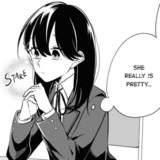
It’s an interestingly morally ambiguous story, with the introspection-driven drama leaving us not quite sure if we’re seeing anything objectively – Yuki’s features are exaggerated to the point of being creepy, while Kyouko’s image appears as dishevelled as she imagines herself to be. We only see Yuki’s real face on the final page, in the mirror: the truly concerned friend who admires and wants to be closer to Kyouko. It’s clear that both of them behave in shitty ways, though only one has the composure to appear normal. One is left with a feeling of hopelessness: Kyouko is trapped by her expertise, friendships, and own mental state in this toxic way of thinking that there seems to be little reprieve from; her blinding self-hatred means she can’t even accept that Yuki is human too.
The story is intrinsically tied to modern, adult life, which is interesting to see from the author and manga in general, and is something we saw before in this anthology in Homecoming. Because of this commitment to harsh realism, it seems to inherit an overall grey tone. I think it’s nice to see the world around us reflected so clearly, but it can also make it harder to empathize with the characters in comparison with some of her stories that make liberal use of supernatural, symbolic, or dramatic elements.
The other motif is of flowers, which will presumably be elaborated on in further chapters from the Flowers and Scars trilogy. Yuki appears to be surrounded and protected by them – whether in her flower coffin or the religious imagery of the crown of roses – while Kyouko can only hold them, or look at a mirror that is bordered with them. Rather unsubtly, the flowers represent that which Kyouko envies. I’m not sure what the significance of roses in particular is; we’re not given the colour of the rose, so it could mean multiple things in flower language.

.jpg?1777608780)
.jpg?1595038535)


.jpg?1785035973)